In September 1990 a reader sent Marilyn vos Savant’s Parade column a small brain-teaser lifted from an old American game show, Let’s Make a Deal. Her reply set off one of the oddest public quarrels in the history of mathematics. By the time it died down she had collected close to ten thousand letters telling her she was wrong, nearly a thousand of them signed by readers with PhDs.
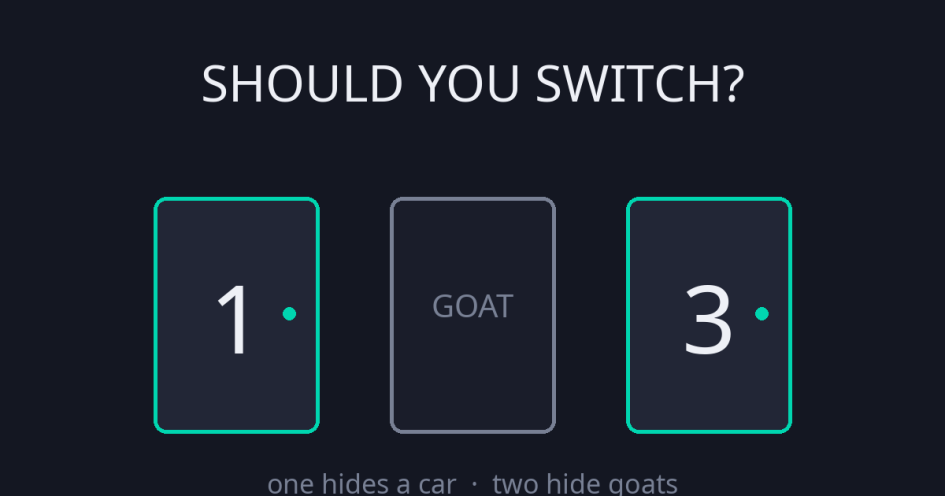
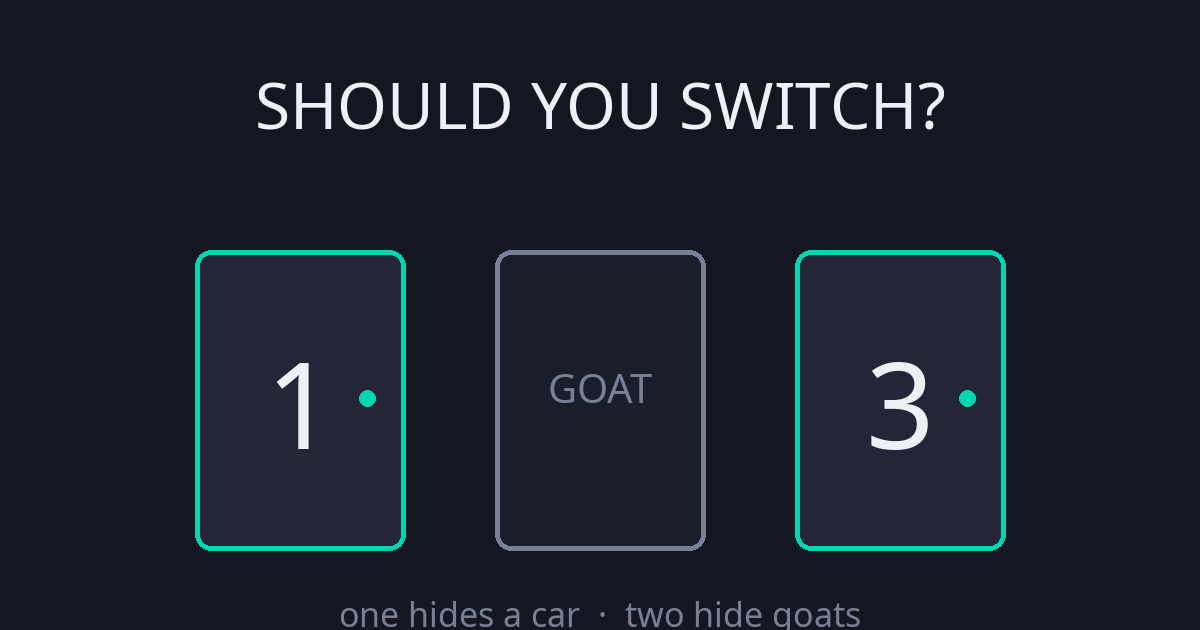
Here is the puzzle. Three closed doors face you. Behind one is a car; behind each of the others, a goat. You pick a door, say Door 1. The host, who knows exactly where the car is, opens one of the two you didn’t choose and shows you a goat. Then he makes his offer: keep Door 1, or switch to the last unopened door. Does the switch change anything?
Most people say it can’t. Two doors remain, one hides a car, so it feels like a clean coin flip. Vos Savant said otherwise. Switch, and your odds climb from one in three to two in three. Stay, and you double your chance of walking off with a goat.
The mail was savage. Professors of mathematics wrote to say she was setting the country’s schoolchildren back, and that the least she owed her readers was a printed retraction. She owed them nothing. She was right, and every furious correspondent was wrong.
Why the coin-flip feeling lies
The whole thing turns on what the host does. He will never open the door with the car behind it. He can’t, and the rules won’t let him. His move is not a random reveal, and that is exactly where the information hides.
Go back to your first pick. When you chose Door 1, you had one chance in three of landing the car, which means two chances in three that the car sat behind the doors you skipped. Opening a goat door does nothing to that original two-thirds. It just pours all of it onto the single door you didn’t pick and the host didn’t open. Your door is still worth a third. The other is now worth two.
If three doors won’t convince you, blow the numbers up. Picture a hundred doors and one car. You pick Door 1, a one-in-a-hundred stab in the dark. The host now opens ninety-eight other doors, every last one a goat, and leaves your pick beside a single survivor. Still feel like an even bet? The other door is carrying ninety-nine doors’ worth of odds on its back.
Even the professionals dug in. When the mathematician Andrew Vazsonyi walked Paul Erdős, one of the most prolific mathematicians who ever lived, through the answer, Erdős brushed the reasoning aside and would not have it. What finally moved him was a computer simulation playing the game hundreds of times over, settling again and again on two-to-one for switching.
The puzzle still catches almost everyone, because our gut insists the two last doors are twins. They never were. One of them only survived your guess. The other survived the host’s choice, and that is worth twice as much.