Brides wear veils because the veil has been part of the wedding for so long that it is built into the language. The English word “nuptial” comes from a Latin verb that meant to veil oneself. Roman brides wore a bright yellow veil, and the white bridal look of today owes a great deal to one wedding in London in 1840.
To marry was to veil
Webster’s dictionary of 1913 traces “nuptial” to the Latin nuptiae, marriage, from nubere, which it says meant “to cover, to veil, hence, to marry, as the head of the bride was covered with a veil.” In Latin a woman did not simply get married. The verb for her side of it was the same as the verb for putting on a veil.
The Roman yellow veil
The Roman veil was not white. William Smith’s Dictionary of Greek and Roman Antiquities, published in London in 1875, describes the Roman bride’s outfit from ancient sources. She wore a long white robe, the tunica recta, tied with a girdle “which the husband had to untie in the evening.” Over her head went “the bridal veil, called flammeum”, which “was of a bright-yellow colour”. Her shoes were yellow too, and her hair was parted with the point of a spear.
So for Romans the veil marked the bride out by its color. It did not hide her in white.
Queen Victoria’s lace
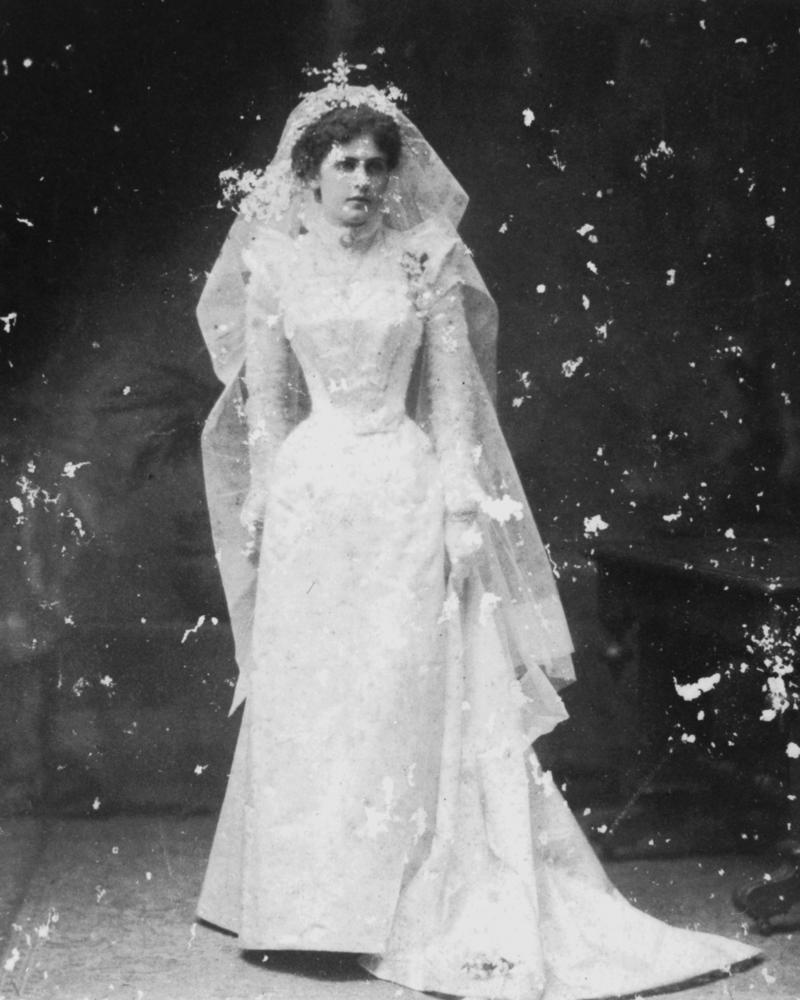
The modern white wedding owes much to Queen Victoria. When she married Prince Albert on 10 February 1840, she wore a white satin dress trimmed with lace and, on her head, a wreath of orange blossoms and a lace veil.
A Devon newspaper, the Western Times, described it five days later: “Her Majesty the Queen wore on her head a wreath of orange blossoms and a veil of Honiton lace.” The lace was actually made in the nearby village of Beer, where lacemakers were struggling. According to the paper, the veil “afforded employment to the poor lacemakers for more than 6 weeks” and was a good yard and a half square. The lace for the dress, it said, employed more than 200 people.
The Fashion Institute of Technology in New York, in its study of the dress, says that by choosing white Victoria “broke from royal custom and encouraged a lasting tradition for Western bridal fashion.” It quotes the curator Jennifer Steadman: “She wanted to be seen as his wife, so she didn’t wear the red ermine robe of state. She wore white. After that, all representations in Godey’s and other fashion magazines picked up on that.”
Victoria kept the veil. FIT notes that she “treasured her lace flounce and veil, and continued to wear them to special occasions throughout her life,” including the 1893 wedding of the future King George V. A popular story says she was buried in it. FIT calls that a myth.
Why the veil stayed
Put together, the history gives two answers. The ancient one is that covering the head was part of what it meant to be a bride: the word for it shaped the language of marriage. The modern one is that a young queen in white lace started a fashion that the magazines spread. The veil changed color from yellow to white, but it stayed on the bride’s head.