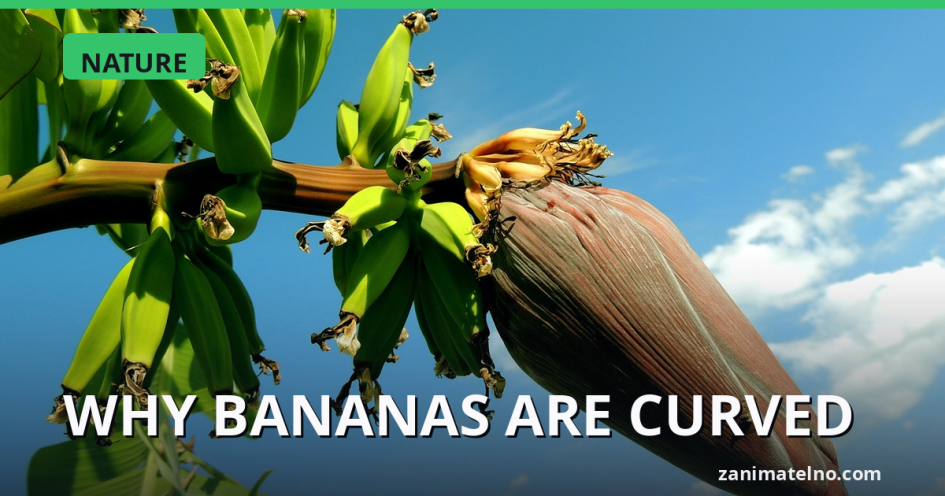
A banana is curved because it grows the wrong way up. On the plant, the bunch hangs upside down from its stalk, and each fruit, instead of pointing at the ground like an apple or a plum, turns and grows upward. The bend you see in the fruit bowl is the fruit changing direction halfway through its growth.
How a bunch ends up upside down
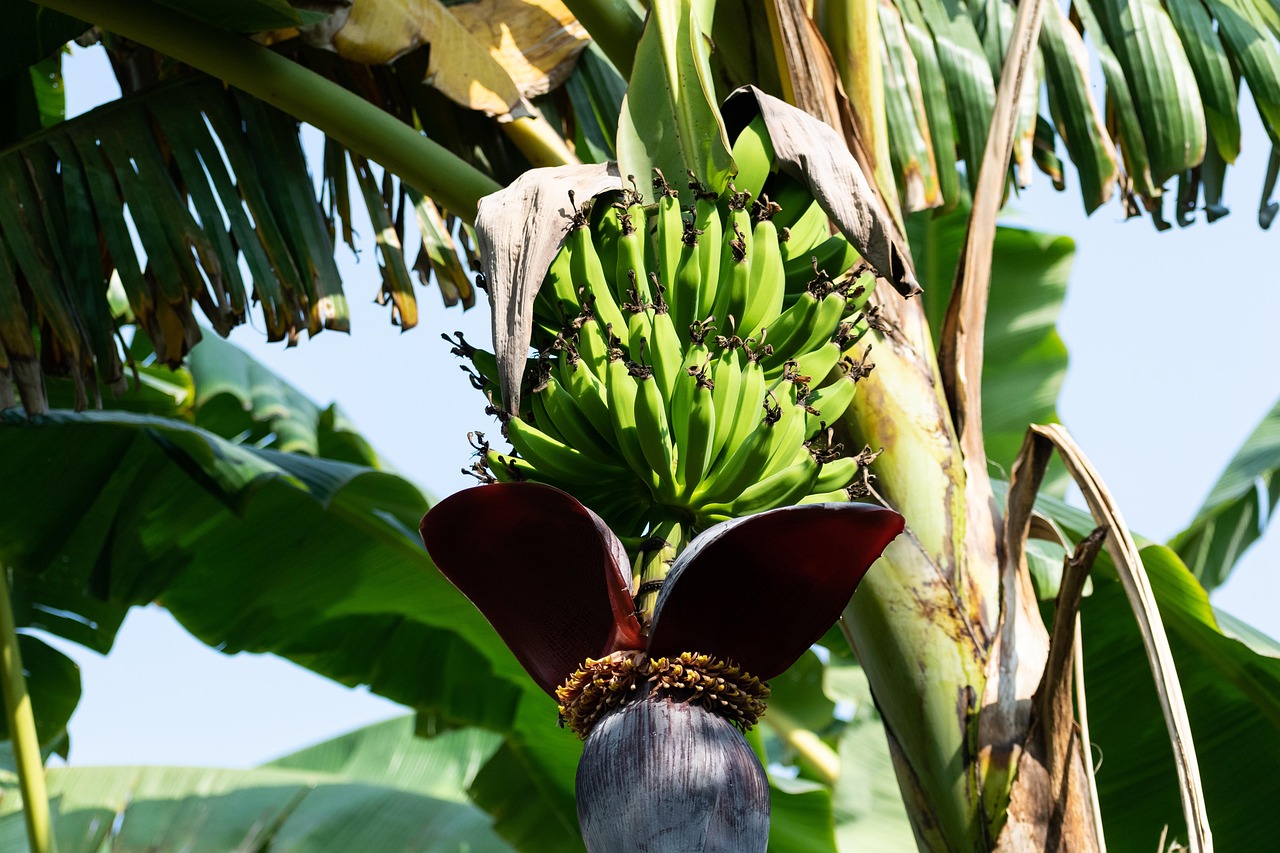
The botanist Julia Morton described the process in Fruits of Warm Climates (1987). The flower stalk pushes up through the middle of the plant and comes out of the top as a large purple bud. Rows of small white flowers sit along the stalk, each cluster covered by a thick waxy bract, purple outside and deep red inside. The female flowers, which become the fruit, occupy the lowest rows.
“In some types the inflorescence remains erect,” Morton wrote, “but generally, shortly after opening, it begins to bend downward.” The young fruits develop from the female flowers and, in her words, “look like slender green fingers”. The bracts fall off, each cluster becomes a hand of bananas, and “the stalk droops with the weight until the bunch is upside down.” That is why banana growers talk about hands and fingers: a bunch really is a stack of hands with the fingers pointing out.
The turn toward the light
The usual explanation is that once the bracts are gone and the young fingers are in the open, they stop following the stalk and curve upward. Banana explainers call this negative geotropism, meaning growth against gravity, and most add that the fruit is also reaching for light. Plants usually steer this way by growing faster on one side than the other. A cell that lengthens more on the lower side of a finger pushes the tip up, and the fruit bends.
The signal behind that uneven growth in plants is usually a hormone called auxin, and fruit curvature has been traced to it directly in at least one crop. A 2020 study in Horticulture Research by Li and colleagues compared the two sides of curved cucumbers. They found that uneven auxin distribution made the fruit curve, and that when a gene called CsYUC10b evened the auxin out, both sides grew at the same rate and the cucumbers came out straight. We could not find an equivalent study done on bananas, so the auxin part of the banana story is an inference from how plants work in general, even if it is a reasonable one.
Not every banana bends
If the curve comes from fingers turning upward on a hanging bunch, then the way the bunch hangs matters, and not every banana hangs. Morton describes the Fe’i bananas of Polynesia as distinguished by erect bunches that stand up instead of hanging. They are a separate group from the supermarket banana, with orange or copper-coloured fruit and purplish-red sap that islanders once used as ink and dye.
Even among ordinary bananas the curve varies a lot. Morton lists fruit from 2.5 to 12 inches long, with shapes running from “oblong, cylindrical and blunt” to “pronouncedly 3-angled, somewhat curved and hornlike”.
A berry that grows upward
Morton adds one more detail that surprises people: botanically, the banana fruit is a berry. The common cultivated bananas are also generally seedless, Morton notes, and develop without pollination, which ProMusa, a banana research network, describes as producing fruit parthenocarpically. So the fruit in your hand is a seedless berry, grown from a flower at the bottom of an upside-down stalk, that spent its life bending toward the sky.