Planes still have ashtrays because the law requires them, and the law requires them because some people still smoke on planes. Smoking has been banned on US passenger flights for decades, but the Federal Aviation Administration’s position is simple: if someone breaks the ban, the lit cigarette has to go somewhere safe, and the worst place for it is the paper towels in the lavatory bin.
The rule that sounds like a joke
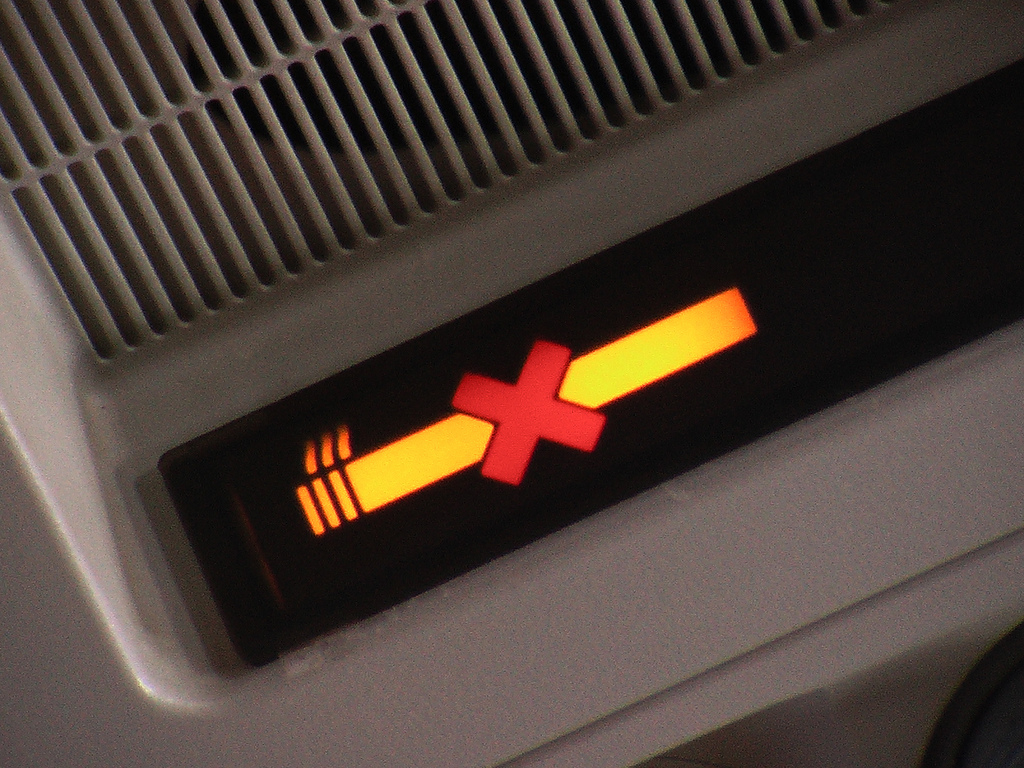
The requirement sits in the federal design rules for airliners, 14 CFR 25.853. Paragraph (f) says plainly: “Smoking is not allowed in lavatories.” Paragraph (g) then says: “Regardless of whether smoking is allowed in any other part of the airplane, lavatories must have self-contained, removable ashtrays located conspicuously on or near the entry side of each lavatory door.” One ashtray may serve two doors if it can be seen from both.
So the ashtray is not a leftover from the smoking era that nobody bothered to remove. It is a required part of the plane, placed next to the sign that forbids what it is for.
Fires in the waste bin
The rule grew out of real fires. In a proposal published in June 2026, the FAA recounts that “after multiple fires in the 1970s started in lavatory waste receptacles”, it issued an airworthiness directive, AD 74-08-09. That order applied to all transport category airplanes with paper or linen waste bins in their lavatories. It required no-smoking placards, an announcement to passengers, regular checks that the bin doors close properly, and a self-contained, removable ashtray on or near the entry side of each lavatory door. A 1996 FAA notice adds that those fires “were caused by, among other things, the improper disposal of smoking materials in lavatory waste receptacles.”
The smoking ban did not end the argument
Congress banned smoking on US flights in steps. A law of December 1987 began it. By the 1990s the ban covered nearly all domestic scheduled flights, leaving out only flights to Alaska or Hawaii longer than six hours, and a law signed in April 2000 replaced those rules with a broader ban. Airlines then asked whether they still needed ashtrays at all.
In the mid-1990s the Air Transport Association petitioned the FAA to let planes fly with the lavatory door ashtrays missing. Its argument was that the ban was well known and that the ashtrays served “as an open invitation for passengers to smoke.” The FAA said no. It pointed to 66 recorded violations of the smoking ban on airlines between 1 January and 17 August 1995 and wrote that “it is evident from these reports that smoking still occurs where prohibited.” The ashtray, it explained, “ensures there is a place to dispose of smoking material in the event the smoking ban is not adhered to”, and gives anyone who boards with a lit cigarette “an obvious location to dispose of smoking material before entering the lavatory.”
What the FAA did offer was a little slack. Its 1996 proposal would let a plane fly for 10 days with one lavatory door ashtray missing, or for 3 days if it had only one such ashtray. The change was adopted that June, and in 2012 the allowance was extended again, as long as at least half of the required ashtrays were in place.
Why smoke detectors are not enough
Airlines and an industry advisory committee have asked again more recently. Lavatories now have smoke detectors and built-in fire extinguishers in the waste bins, they argued, so the ashtray rule could go. The FAA’s June 2026 proposal still says repeal “would not be in the public interest.” Its reasoning is that lavatory smoke detectors “are not installed to detect cigarette smoke, though this is a common misconception”, so detection “might not occur until paper is smoldering or a fire is developing.” Without ashtrays, it says, there would be “no method of safe disposal of lit cigarettes.”
The same proposal offers the airlines a compromise. Instead of insisting on a removable ashtray, the rule would ask for “an approved means to dispose of lit combustible material safely” by each lavatory door. Part of the reason is practical: today’s ashtrays keep going missing, and the FAA mentions designs that would be “less likely to be missing or stolen.” The ashtray may change shape, but the FAA has not given up on having one by the lavatory door.