The Halloween colors are orange and black. Americans have called them “Hallowe’en colors” for more than a century, and in the written record the pairing spreads through party guides and crepe paper rather than ancient ritual. By the 1920s a party report could say a hall was decorated “in the usual way”, and everyone knew what that meant.
“In the usual way”
The phrase “Hallowe’en colors” was already ordinary newspaper language before the First World War. In November 1913 the Clearfield Progress reported a party where the house was “gaily decorated in Hallowe’en colors”. It did not bother to say which colors. Readers were expected to know.
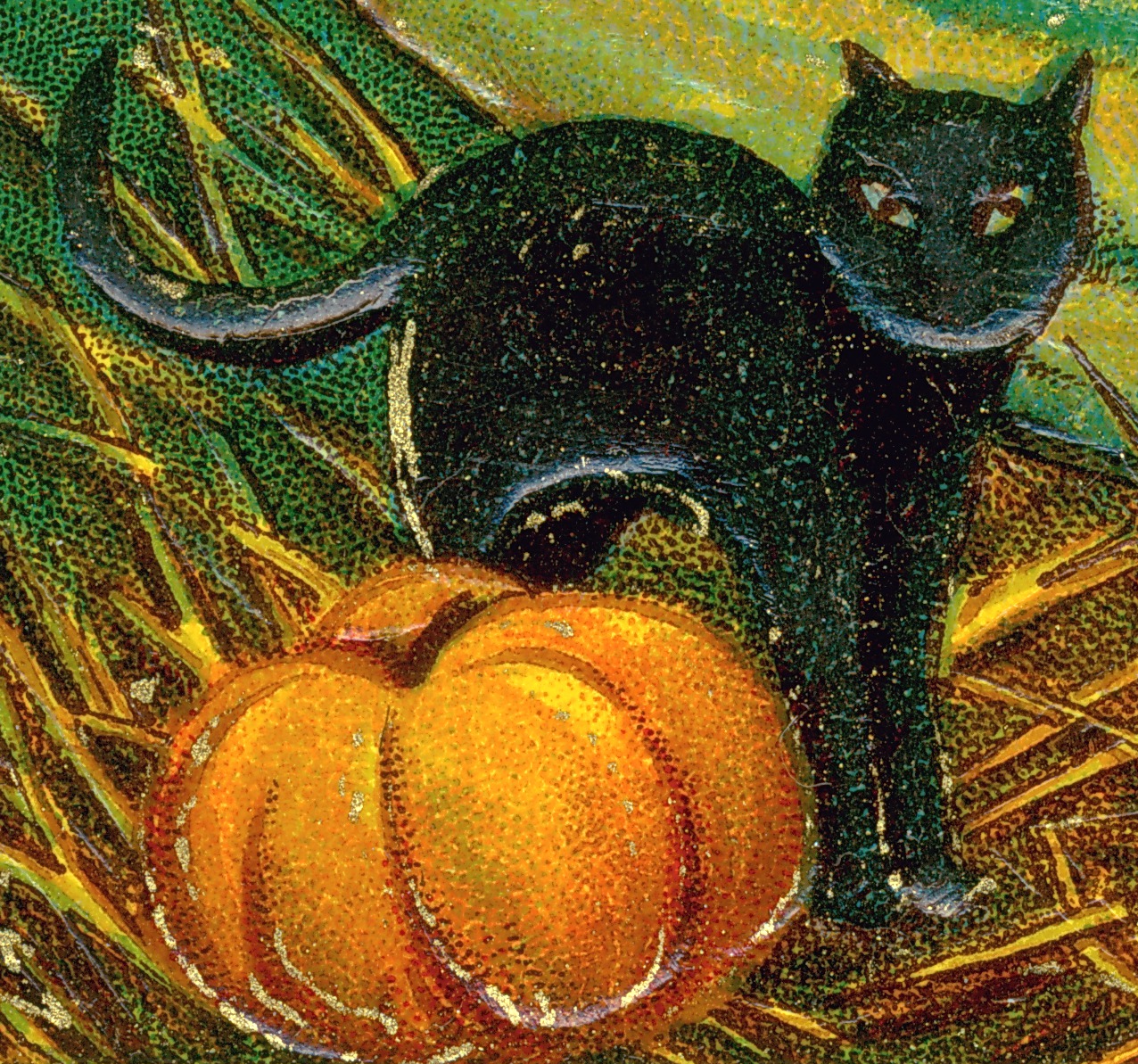
A decade later the habit was firm. In December 1923 the Pacific Telephone Magazine, a company magazine, described a staff party in Spokane: “The hall was decorated in the usual way, in Hallowe’en colors of orange and black, witches, cats, owls, and bats.” Orange and black had become the default, listed alongside the cats and bats.
The crepe paper company
One business pushed the look every year. The Dennison Manufacturing Company of Framingham, Massachusetts, made crepe paper, cut-outs and party goods, and every year it published a guide called the Bogie Book, “A Book of Suggestions for Decorating and Entertaining at Hallowe’en, Harvest Time and Thanksgiving”. The copy digitized by the Internet Archive is the 13th annual edition, from 1920.
Its instructions are full of the two colors. “Decorate the living rooms with vivid orange and black,” it advises. The doorway gets “orange, yellow and black crepe paper moss”, a black crepe-paper spider on elastic, and the chandelier “sheds a weird glow over the whole room through the long orange crepe paper fringe that surrounds it.” Invitations, it says, are often “orange colored”.
Items come with catalogue numbers: pumpkin cut-outs, “No. 2 Orange Streamers”, borders H 6, H 7 and H 8. A company that sold orange and black paper had good reason to teach America that Halloween was orange and black, and it printed a new edition every year to do so.
Not always orange
The scheme was common but not fixed. Dennison itself mixes in yellow. A Hallowe’en party in Bay St. Louis, Mississippi, reported in the Sea Coast Echo in November 1938, had decorations “in yellow and black”. Yellow, like orange, is the color of autumn leaves, corn and pumpkins.
Why these two?
You will often read that orange stands for the harvest and the bonfires of the old Celtic festival of Samhain, and black for death and the dark half of the year. It is a reasonable reading of what the colors suggest: pumpkins, autumn leaves and candlelight on one side, night, black cats and witches on the other. But we found no early source that explains the choice in those terms. The party guides and newspapers of the early 1900s simply use the colors without explaining them.
What the record shows is how the colors spread. Halloween in America became a party holiday, and parties need decorations. The companies that made them and the newspapers that reported them helped settle on orange and black, and by the 1920s it was “the usual way”.