
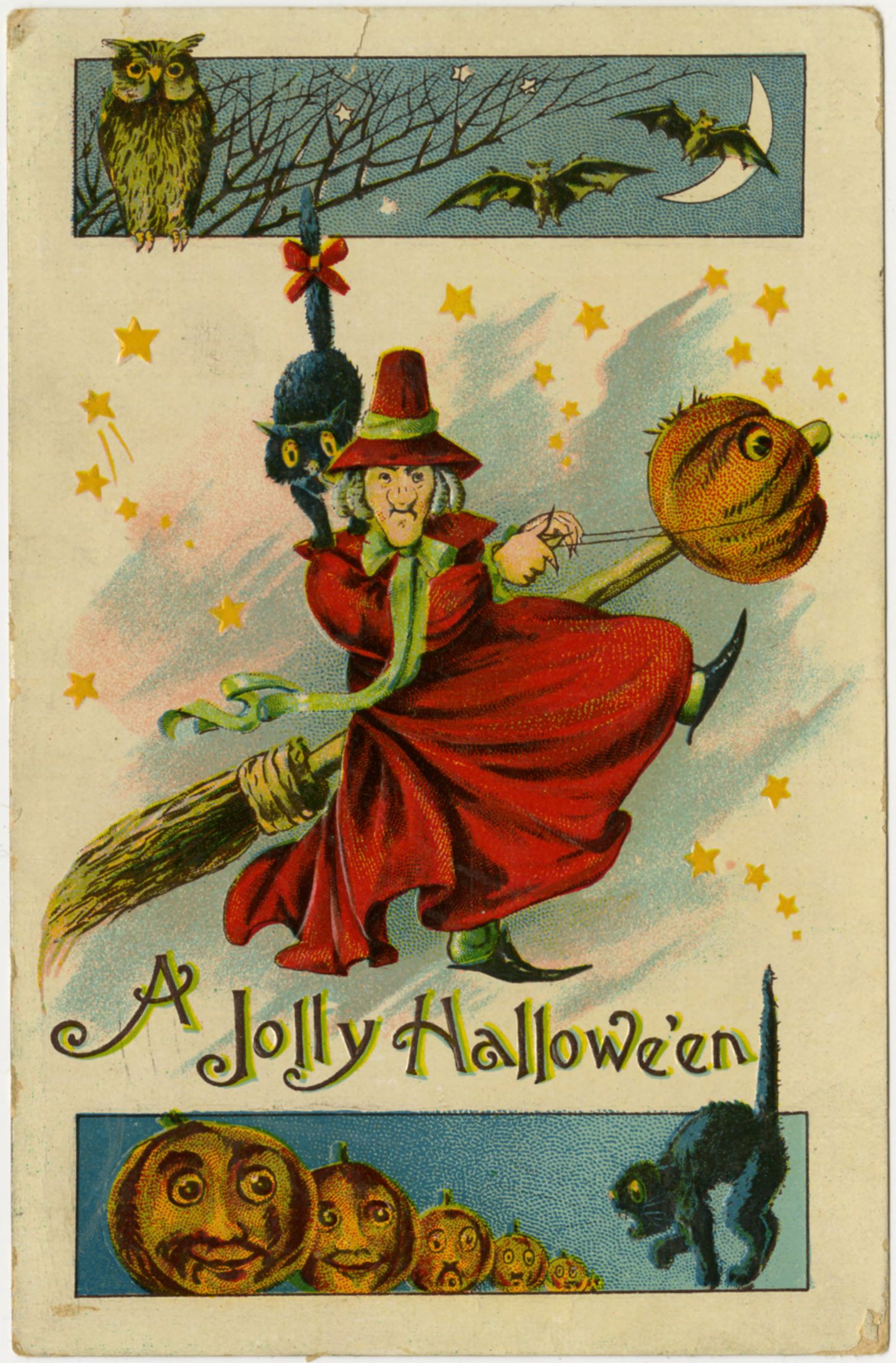
Witches ride brooms because the people who wrote about witches in the 1400s put them there. The idea took shape in the writings of churchmen and judges in the early 15th century, and the broom fit because it was an ordinary household tool, the kind of thing any woman would have in her home. The image is not ancient. Its earliest known picture is from 1451.
The first flying witches
Michael D. Bailey, a professor of history at Iowa State University who studies medieval witchcraft, explains in The Conversation that “several theologians, church inquisitors, secular magistrates and other authorities first wrote about such flight in the early 1400s.” The earliest known image of it, he writes, “appears in a 1451 manuscript copy of one such text, ‘Le champion des dames’ (‘The Defender of Ladies’), by the French poet Martin Le Franc.”
The flying women in that picture ride household tools and are dressed plainly. Bailey points out that their clothing shows them “as coming from non-elite ranks of medieval society. So do the implements on which they fly. Staffs and brooms were tools for ordinary housework.”
In this picture a witch was not an exotic sorceress. She looked like an ordinary woman, holding something every household owned.
Why they needed to fly
Flight solved a problem for the witch-hunters’ theory. They believed witches gathered in large secret meetings called sabbaths. Bailey explains that “the notion that witches could fly served to support the idea that they gathered in large groups”, and those gatherings made witches seem a far greater threat to Christian society.
The texts did not agree on what they flew on. According to Bailey, one described witches riding to sabbaths on staffs anointed with a magic ointment; another said accused witches claimed to fly from mountaintop to mountaintop on chairs.
The witch-hunters’ handbook
By the end of the century the broom was in the witch-hunting manual Malleus Maleficarum, or Hammer of Witches, first published in the 1480s. In the English translation of 1928, its authors describe how witches travel. They take an ointment that, the book claims, the devil teaches them to make from the bodies of murdered children, “and anoint with it a chair or a broomstick; whereupon they are immediately carried up into the air, either by day or by night, and either visibly or, if they wish, invisibly”.
The chair and the broomstick appear side by side. Over time it was the broom that stuck.
Doubters, even then
Not everyone believed it. Bailey notes that many writers of the time, Le Franc among them, were skeptical, and Le Franc declared that anyone who thought witches could fly lacked “common sense”. Older church law already treated night flight as illusion. An early 10th-century church law, Bailey writes, said that women who claimed to ride at night with the goddess Diana had been “seduced by illusions and phantasms of demons.”
Did the accused women themselves claim to fly? Bailey says the most thorough study of the trial records finds that such claims “rarely appear in voluntary testimony”. They came instead from the authorities recording, and often reshaping, what the accused said. The skepticism hardly mattered: “Courts could execute convicted witches regardless of whether they believed they could fly.”
The trials ended, but the picture lasted. The broom you see on Halloween decorations is the same household tool that 15th-century judges imagined could carry an ordinary woman over the rooftops.