Bobbing for apples most likely came to America from the Halloween parties of Scotland and Ireland, where catching an apple with your teeth was one of the standard games of the night. In Scotland it was called dooking. In Ireland there was a harder version with lit candles, and it gave the whole evening a name: Snap-Apple Night.
Dooking in a Scottish kitchen
One of the liveliest descriptions comes from The Leisure Hour, an illustrated magazine for home reading, in a Scottish Halloween story it printed in December 1874. The narrator remembers the evening:
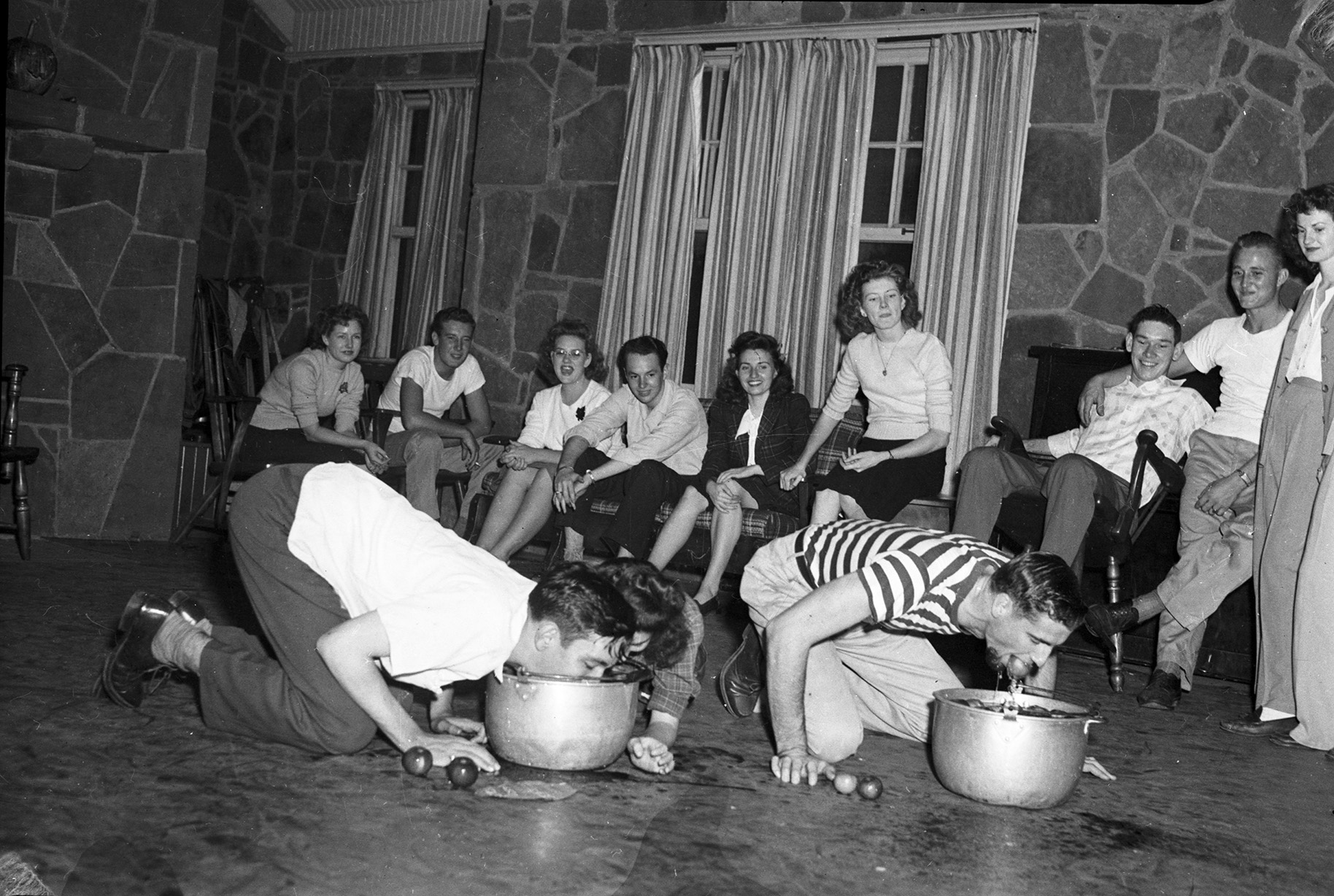
“We began the night first of all, of course, with dooking for apples. The mistress had a big washing boyne half full o’ water set in the middle of the kitchen floor, and about a dozen apples were tummult into it at a time.”
The boyne was a washing tub. The players took turns, and the fun was watching them fail: “it was good fun to see how drookit some got, both lads and lassies, the water streaming down from their hair and lugs (ears) and een, with plunging their heads too far down in hunting for some red-cheeked apple that they couldna catch, though it bobbed against their lips.” The big-mouthed ones did best. One lad, the story says, “grippit two at once twice running.”
The phrase “of course” says a lot. For the narrator, Halloween without dooking was hardly Halloween.
Snap-Apple Night in Ireland
In Ireland the game was so central that it named the festival. In 1837 the Literary Gazette reviewed an engraving of a painting by Daniel Maclise, Snap-Apple Night; or, All Hallow Eve, which showed an Irish Halloween party. It quoted a long description by the writer Lover, who begins by teasing his English reader: “I see you have never been in Ireland, by the question, and I pity you.”
Lover then explains the game that “gives the evening its name”. It was not a tub of water. It was a spinning contraption: “whirling cross-bars of lath, with flaring candles at two opposite ends of the merry-go-round, and tempting apples at the other”. A player tried to bite an apple as it swung past. One man in the picture is “grinning with pain, having made an unsuccessful bite, and caught the candle instead of the apple”. Somebody else gives “the machine a malicious twitch to increase its speed”.
Lover’s description also shows what else went on that night. Next to the apples, a girl holds two nuts on a fire-shovel to burn them, “emblems of their own hearts”. If they burned steadily together, the couple’s love would last. Apples and nuts at Halloween were as much about fortune-telling and courtship as about fun.
Across the Atlantic
The usual explanation is that Scottish and Irish emigrants brought the game with them. However it crossed the Atlantic, it shows up in ordinary American party reports. One small example from a Mississippi paper, the Sea Coast Echo, in November 1938, reports that at one local party “one of the interesting features of the evening’s entertainment was ducking for apples out of a fish pond.”
The candles have mostly gone, and so has the washing tub. The idea is unchanged: an apple that will not stay still, and a crowd laughing at how wet you get.