The haunted house as entertainment, a place you pay to enter so that you can be frightened, owes a large debt to a trick with a sheet of glass. In London at Christmas 1862, John Henry Pepper of the Royal Polytechnic Institution put a ghost on stage that walked among living actors, and audiences could not work out how it was done. Pepper later wrote the story down himself, in a little book called The True History of the Ghost, published in 1890.
A patent agent’s idea
The idea did not start with Pepper. He credits a Mr. Dircks, “a patent agent, who had saved some property and was an independent man”, who had written a paper describing “an optical effect that could be performed with sheets of glass”. Nobody took much notice, Pepper says, “because the explanation of it was somewhat vague and unsatisfactory.”
Dircks also had an impractical plan for it. According to Pepper, he insisted that “an entirely new theatre must be built” to show the effect, and that it could only be seen “by a few people placed in an upper gallery, and then only by daylight”. Other London showplaces had turned him down.
Christmas 1862 at the Polytechnic
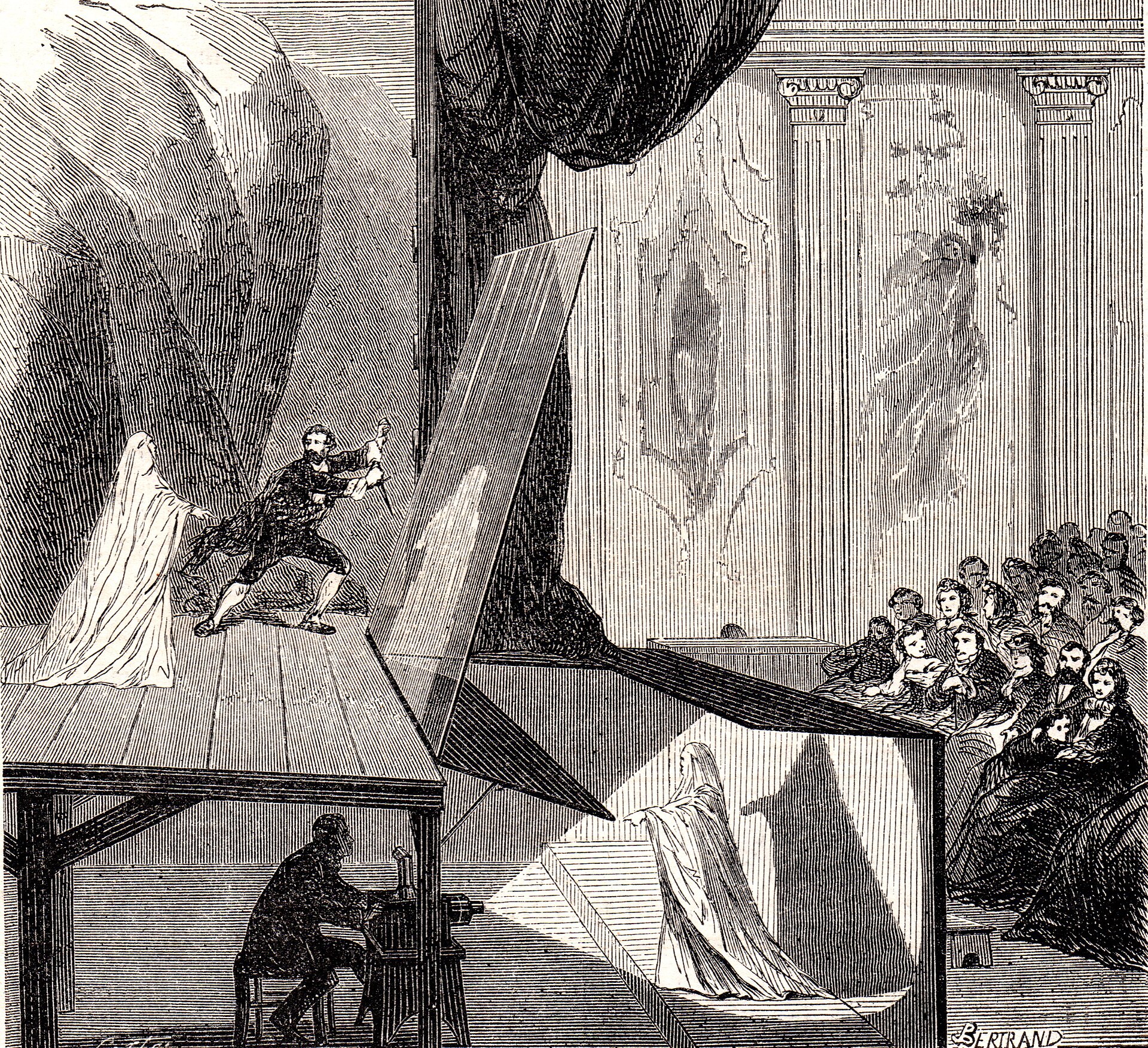
The Polytechnic’s halls and lecture rooms, Pepper writes, had been crowded during the exhibition year and were now half empty. Late in 1862 instrument makers showed him a model Dircks had built. Pepper reworked the arrangement so that it could be shown “in any lecture hall or theatre, if sufficiently large to contain the necessary apparatus.”
The principle, as the book describes it, is simple. Below the visible stage is a hidden one, “strongly illuminated by artificial light”. A large sheet of glass stands on the main stage. “The spectators will not observe the glass screen, but will see the actors on the ordinary stage through it as if it were not there; nevertheless the glass will serve to reflect to them an image of the actors on the hidden stage”. Darken the hidden stage and the ghost vanishes.
Pepper first showed it to an invited audience of writers, scientists and journalists. The effect, he wrote, “was startling in the extreme”, so much so that instead of explaining the trick as planned he went to the patent agents the next day and filed a provisional patent “in the names, at my request, of Dircks and Pepper.”
A ghost that paid
The public came in crowds. The show moved to the Polytechnic’s large theater, with a scene from Charles Dickens’s Christmas story The Haunted Man, which Dickens, Pepper says, allowed him to use by special written permission. “This ghost scene ran for fifteen months, and helped to realise, in a very short time, the sum of twelve thousand pounds,” Pepper wrote, not counting what he earned from licensing the ghost to others.
Not everyone was pleased. Elsewhere in the book Pepper recalls that people who made money out of so-called spirit mediums “fairly howled upon me in the lecture room”.
From the Polytechnic to the theme park
Pepper’s ghost showed that a haunting could be built, lit and sold tickets to. More than a century later, the haunted house got its most famous address. On 9 August 1969, Disneyland opened the Haunted Mansion. According to the Disney Parks Blog, construction began in 1961 and the outside was finished by 1963, but the building stood empty for years while Walt Disney’s Imagineers worked on the 1964–65 New York World’s Fair, experience that “made way for some of the technology that’s used in the Haunted Mansion.” Walt Disney never saw it finished.
The details changed over a century, but the basic deal of the haunted house stayed the same as at the Polytechnic. Visitors pay to be shown something impossible, and the fun lies in not knowing how it is done.