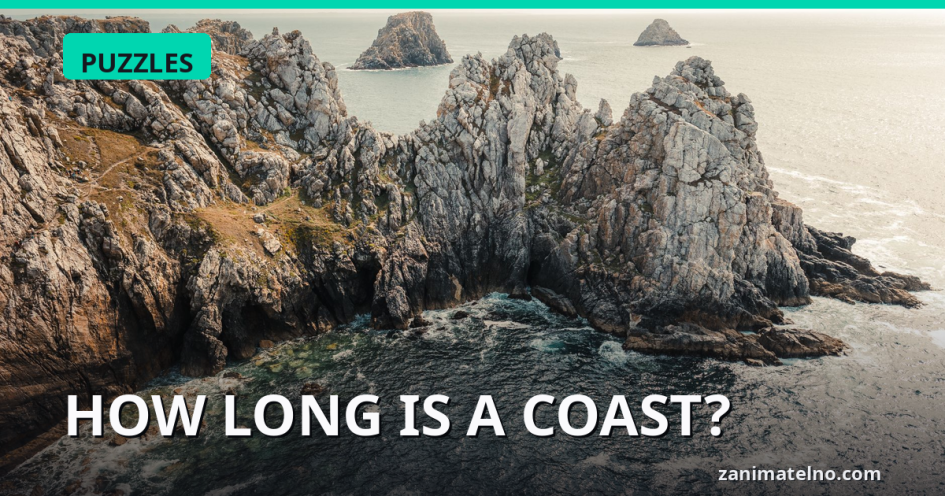
Ask how long the coastline of Britain is and you will not get one answer. You will get a different answer for every ruler you use, and the shorter the ruler, the longer the coast becomes. Measured in straight 100-kilometre steps, Britain’s coastline runs to roughly 2,800 kilometres. Switch to 50-kilometre steps and it stretches to about 3,400 kilometres. The land did not change. Only the ruler did.

This is the coastline paradox, and the reason behind it is that a coast is nothing like a straight line. A long ruler steps straight across every bay and headland, ignoring them. A shorter ruler dips into those bays and traces those headlands, catching detail the big ruler skipped, and adding length. Shrink the ruler to the size of a boulder and you start following the outline of individual rocks. Shrink it to the size of a grain of sand and the number balloons further still. There is no natural point where the wrinkles stop.
The effect was first noticed by the British scientist Lewis Fry Richardson, who was studying whether the length of the border between two countries affected their chances of going to war. He found something odd in the reference books: Spain listed its border with Portugal as 987 kilometres, while Portugal put the same border at 1,214 kilometres. Neither was lying. They had simply measured with different-sized rulers.
Richardson’s stray observation was picked up by the mathematician Benoit Mandelbrot, whose 1967 paper carried the deliberately odd title “How Long Is the Coast of Britain?”. Mandelbrot showed that coastlines are self-similar: a small stretch of coast, magnified, looks much like a large one, jagged at every scale. He would later give shapes with this endless nested detail a name, fractals, and build a whole geometry around them.
So the honest answer to the original question is that a coastline has no single length. It has a length for each scale of measurement, and those lengths climb without limit as you look closer. A map can tell you a country’s area exactly. Its perimeter, it turns out, is a matter of opinion about rulers.