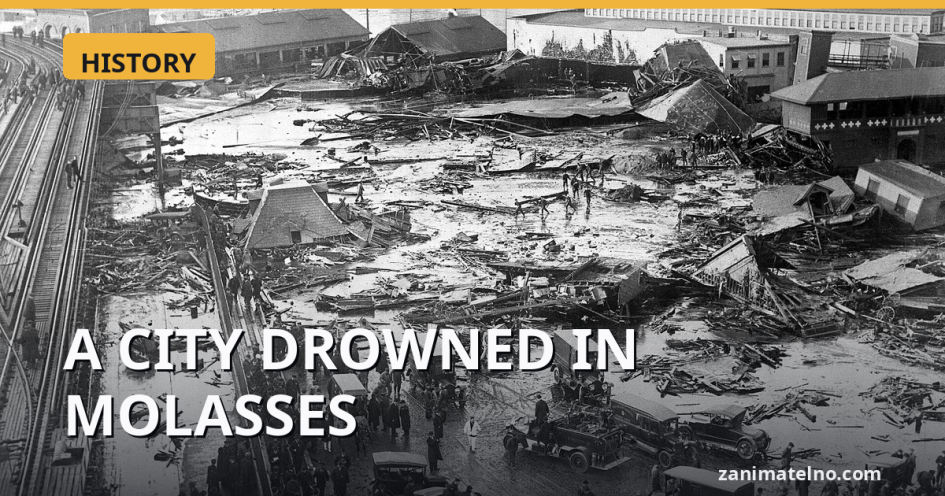
Just after half past noon on 15 January 1919, people in Boston’s North End heard a low rumble and a burst of sound like machine-gun fire as rivets shot out of a steel tank. A moment later a wall of molasses, somewhere between two and five storeys high, was moving through the streets at about 35 miles an hour. By the time it stopped, 21 people were dead and about 150 injured. It is remembered, not entirely as a joke, as one of the strangest disasters in American history.

A tank that should never have held
The tank belonged to the Purity Distilling Company, part of United States Industrial Alcohol, which turned molasses into industrial alcohol for munitions and liquor. Built in 1915, it stood more than 50 feet tall and 90 feet across and held 2.3 million gallons of molasses, weighing roughly 13,000 tons.
It had been a bad tank from the day it went up. It was raised in a hurry, never properly tested, and it leaked so steadily that local children collected the drips in cans. Rather than fix it, the company had the tank painted brown, which hid the seeping molasses from view. Residents said it groaned and rumbled whenever it was filled. Those were the sounds of a structure under stress, and no one acted on them.
The wave
When the tank finally failed, it failed all at once. The steel plates tore apart and the entire contents came out in a single surge. Witnesses described a glistening brown wave 15 to 25 feet high, moving faster than a person could run.
Molasses sounds harmless, even comic, until you picture 13,000 tons of it in motion. The wave snapped a steel support on the elevated railway, lifted a train car, tore buildings off their foundations and swept up people, horses and wagons. Then came the crueller part. As the molasses spread and cooled in the January air, it thickened into a heavy, clinging mass. People and animals caught in it could not pull free, and rescuers who waded in got stuck fast themselves. Some victims suffocated where they lay. It took days to recover all the bodies. Later scientists who modelled the flood found that the cold was the killer’s accomplice: warm molasses would have run off, but chilled molasses turned the streets into a trap that set around its victims like wet cement.
Who paid for it
The company first blamed sabotage, hinting that anarchists had blown up the tank. It did not hold. In one of the earliest large class-action cases in Massachusetts, thousands of hours of testimony established the plain truth: the tank had been structurally inadequate, its steel too thin and too brittle for the load, and every warning sign ignored. United States Industrial Alcohol paid settlements worth many millions in today’s money, and the case is often credited with pushing American engineering toward stricter oversight and certified sign-off on big structures.
The molasses outlasted the lawsuit. Crews flushed the streets with salt water for weeks, and for years afterward people in the North End swore that on a hot day the neighbourhood still smelled faintly sweet.
Why it stuck
The Great Molasses Flood survives partly because the image is absurd: death by syrup. But strip away the strangeness and it is an ordinary disaster with an ordinary cause. A company built something cheaply, ignored the evidence it was failing, and painted over the leaks. The only unusual thing was what happened to be inside the tank. Twenty-one people did not die because molasses is dangerous. They died because a warning was easier to paint over than to fix.