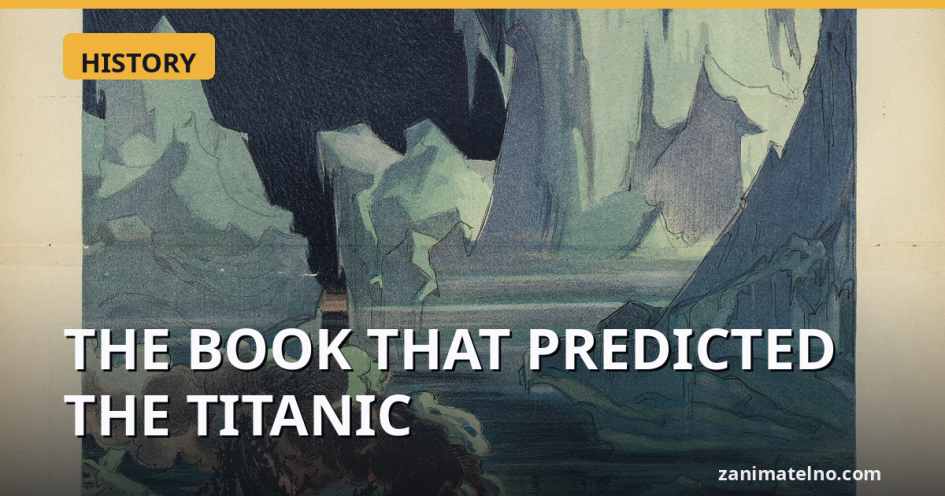
In 1898 a former sailor turned struggling writer named Morgan Robertson published a short novel about the largest ocean liner ever built: a marvel of luxury and engineering, declared practically unsinkable. On an April night in the North Atlantic she strikes an iceberg and goes down, taking most of her passengers with her because she carries too few lifeboats. Robertson called the ship the Titan. Fourteen years later almost every detail came true.

The parallels
When the RMS Titanic sank on 15 April 1912, readers who remembered Robertson’s book were unsettled by how closely the fiction matched the fact. The two ships line up point for point:
- The fictional Titan was 800 feet long; the Titanic was 882.
- Both were called the largest ship afloat, and both were described as practically unsinkable.
- Both struck an iceberg in the North Atlantic, in April, close to midnight.
- Both carried lifeboats for barely half the people aboard, because the law required no more.
- Both went down with catastrophic loss of life.
Even the names rhyme. The coincidence was strong enough that, after 1912, some readers decided Robertson must have seen the future.
Prophet or professional?
Robertson rejected the idea flatly. He was not a mystic, he said, but a man who knew ships. He had spent years at sea in the merchant marine before he started writing, and he followed the industry closely. By the 1890s the trend was obvious to anyone paying attention: liners grew larger every year, competition pushed builders toward one enormous unsinkable ship, and lifeboat rules were dangerously out of date, written for far smaller vessels and never updated. Robertson simply extended the line. A giant liner, overconfident and short of lifeboats, meeting an iceberg on the crowded North Atlantic run was not a vision. It was the most probable disaster of the age, and he wrote it down.
That is the part usually cut from the eerie-prophecy retellings. The lifeboat shortage that doomed the Titanic was not bad luck; it was a known, criticised gap in the regulations. Robertson saw it, and so did plenty of others. He just happened to publish it as a story, with a ship named one syllable from the real thing.
The differences
The match is not perfect, and honesty needs the gaps. Robertson’s Titan was steaming east and sank near Newfoundland; the Titanic was heading west on her maiden voyage. In the first edition the Titan displaced 45,000 tons; Robertson later revised the figure up to 75,000, which has led some to accuse him of tidying the prophecy after the fact. And his sinking is the opening act of a survival-and-redemption plot, not a careful reconstruction of a wreck.
None of that dissolves the coincidence, but it reframes it. Robertson was not seeing 1912. He was reading 1898 clearly enough to know where it led.
What the story is really about
Morgan Robertson died in 1915, three years after the disaster that made his forgotten novel famous. He never grew rich from it and never claimed the gift people wanted to hand him. The tale endures because we love a prophecy, but its real lesson is quieter and more useful. The Titanic was not sunk by fate. It was sunk by exactly the overconfidence a novelist had already sketched: a ship too big to imagine failing, sent to sea without enough boats, on a route everyone knew held ice. Someone had even written the ending. Nobody read it as a warning.