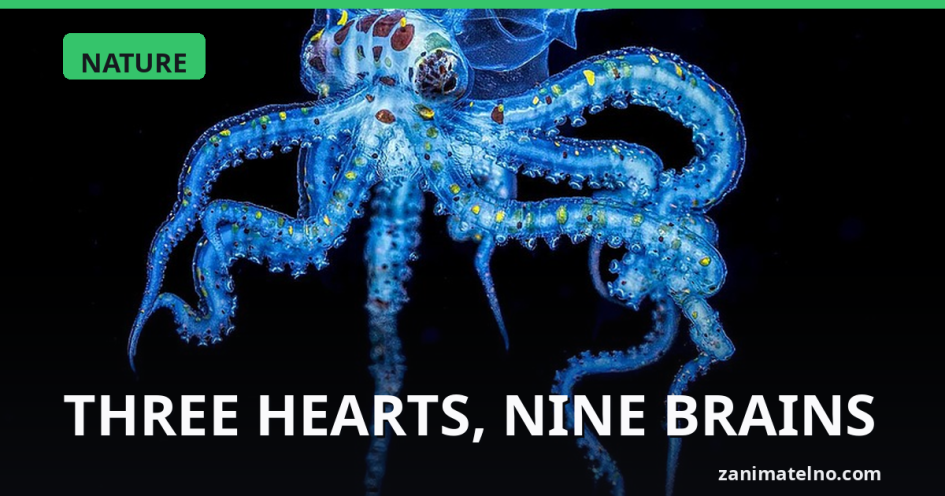
An octopus is built so differently from us that it can feel designed from a different rulebook. It runs on three hearts, its blood is blue rather than red, and its nervous system is so spread out that calling any one part “the brain” shortchanges the other eight. None of this is trivia for its own sake. Each oddity is a solution to the problem of being a soft, quick, clever animal in cold, dark water.
Three hearts, and one that quits
Two of the octopus’s hearts are branchial hearts. Each sits beside a gill and does one job: push blood through that gill to load it with oxygen. The third, the systemic heart, then pumps that oxygen-rich blood out to the rest of the body. Three pumps for one circulatory system.
The strange part is what the systemic heart does when the octopus swims: it stops. Jetting through open water makes the main heart pause, which tires the animal fast and leaves it winded. That single quirk explains a lot of octopus behaviour. Given the choice, an octopus would rather crawl across the seabed on its arms than swim, because swimming literally stops its heart.
Blue blood, for a cold world
Our blood is red because it carries oxygen on hemoglobin, which is built around iron. The octopus uses a different molecule, hemocyanin, built around copper, and copper turns the blood blue. This is not cosmetic. Hemocyanin moves oxygen far more efficiently than hemoglobin in cold water that holds little oxygen, which is exactly the deep, chilly world many octopuses live in. The blue blood is a cold-water engine. It is also why octopuses are so vulnerable to warming, oxygen-poor seas: their whole oxygen system is tuned for the cold.
Nine brains, mostly in the arms
Here is the fact that unsettles people most. An octopus has one central brain, ringed around its throat, and eight more clusters of nerve cells, one running down each arm. Biologists often call it nine brains, and it is more than a figure of speech: roughly two-thirds of an octopus’s neurons are not in the central brain at all. They are in the arms.
So the arms are semi-independent. An octopus arm can taste, touch, reach and grab, and make many of those choices locally without waiting for orders from the centre; a severed arm will keep reacting on its own for a while. The central brain sets the goal, and the arms work out much of the how by themselves, the way a strong team handles the details without checking every move with the boss.
That distributed design may be tied to octopus intelligence, which is real and well documented. Octopuses open jars, solve mazes, recognise individual keepers and squeeze through any gap larger than their beak, the only hard part of their body. An animal that does all this with a brain organised nothing like ours is a standing reminder that intelligence has more than one blueprint.
What it adds up to
Put the pieces together and the octopus stops looking like a bag of weird facts and starts looking coherent. It is a shell-less, boneless animal in a cold, dim place that has to be smart and fast to hunt and to hide. So it runs a high-efficiency cold-water oxygen system in blue, splits the pumping across three hearts, and pushes most of its thinking out into the limbs that do the touching and tasting. When people wonder what an alien mind might be like, they rarely need to look past the nearest tide pool.